Build an emergency document module you can retrieve and hand off.
A binder is only useful if the right person can find it, carry it, protect it, and open the backup. Build four layers, then prove the system in ten minutes.
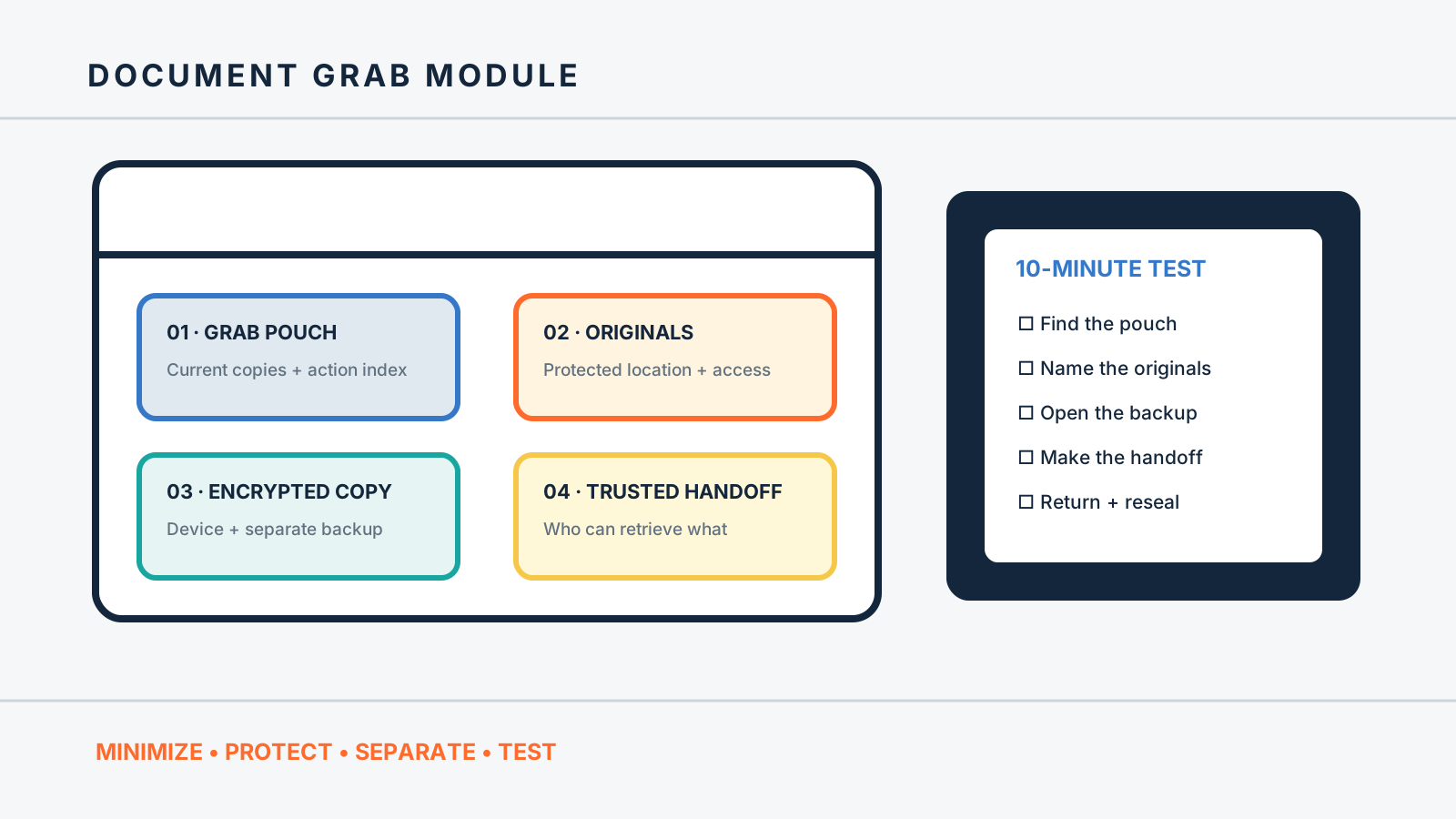
The goal is recovery, not a thicker binder
People usually search for an emergency binder checklist after a wildfire, flood, theft, evacuation warning, or family change makes scattered records feel risky. The common questions are sensible: Which papers matter? Should originals leave the house? Is a waterproof pouch enough? Can a USB drive replace paper? What can a spouse, caregiver, or executor access if the owner is unavailable?
The Consumer Financial Protection Bureau and Ready.gov organize disaster records around a practical outcome: prove identity, contact institutions, document property and income, reach insurance, and establish legal authority. Their Emergency Financial First Aid Kit asks households to assess and compile financial information, review it, safeguard it, and update it. The useful unit is therefore not “every document you own.” It is the smallest current set that helps a household act while keeping sensitive information out of unnecessary circulation.
A single binder creates one point of failure. It can be left behind, soaked, stolen, destroyed with the home, or impossible to open because only one person knows the password. Build a layered system instead. Each layer has a specific job, a different exposure level, and a tested owner.
Use four layers with different jobs
A low-detail contact and location card that helps someone start: people, insurers, institutions, document locations, and next actions.
Current working copies and a small number of originals needed for the specific evacuation, travel, health, or recovery plan.
Irreplaceable, certified, or legally significant documents stored for the hazards they face, with access recorded.
Readable scans on one device or service plus a separate backup, protected and available to an authorized person.
The layers should point to one another without exposing everything. The action index might say “home insurance: carrier, claim number, last four of policy, phone, full copy in blue pouch and encrypted archive.” It does not need every account number, password, or Social Security number printed on the front page.
Keep the index with your emergency handoff card when another person may need to act. Put sensitive records inside an opaque, closable pouch. If you use a fire-resistant or water-resistant container, follow its actual rating and instructions. A plastic sleeve may handle splashes; it does not make paper fireproof, floodproof, or secure from theft.
Start with decisions, then collect documents
- Name the emergencies. A short evacuation, destroyed home, hospitalization, identity theft, and death or incapacity create different document needs.
- Name the people. Include every adult, child, dependent, pet, caregiver, and trusted person whose records or authority affect the plan.
- Name the actions. Examples include filling medicine, checking into lodging, making an insurance claim, proving ownership, contacting an employer, replacing identification, or authorizing care.
- Assign each record a layer. Decide whether the action needs an index entry, working copy, original, certified copy, digital scan, or several.
- Set an access rule. State who carries it, who may open it, where the backup lives, and what happens if the primary person is unavailable.
This keeps the kit proportionate. A renter may need a lease, renters-insurance record, photos, and landlord contact. A homeowner may add mortgage, title location, repair contacts, and a room inventory. A caregiver may need authority documents and an up-to-date health summary. A household with pets can connect vaccination, identification, veterinarian, medication, and boarding records to the pet and medical-needs module.
Build a document inventory by action
| Action | Records to evaluate | Safer module note |
|---|---|---|
| Prove identity and relationships | Government ID, passports, birth or marriage records, citizenship or immigration records, Social Security cards | Record issuing agency, expiration, and protected-original location; carry only what the plan requires |
| Continue health and care | Insurance cards, medication list, allergies, clinicians, pharmacy, medical equipment, directives, caregiver authority | Keep the working health summary current and coordinate it with the medication module |
| Make insurance claims | Home, renters, vehicle, health, life, flood, or other policy information; agent and claims contacts | Include photos or inventory, dates, serial numbers, and evidence of ownership where useful |
| Reach money and income | Financial institutions, benefits, employer, tax records, account access, recurring obligations | Minimize exposed numbers; list institution, purpose, contact, and last four where that is enough to begin |
| Establish property and residence | Lease, deed or title location, mortgage or lender, utility, vehicle title or registration, loan records | Know which recovery process needs a copy, certified copy, or original |
| Establish authority | Wills, trusts, powers of attorney, guardianship, healthcare proxy, advance directive, executor or attorney contacts | Confirm custody, validity, and original requirements with the relevant professional |
CFPB’s disaster checklist also recommends a room-by-room inventory, photos of valuable property, and records for employment and tax information. Do not delay the entire module while trying to make a perfect inventory. Photograph each room from several angles, capture serial numbers for high-value or essential equipment, and schedule a later pass for receipts and replacement details.
For medicines, keep the document layer lean and current: name, strength, instructions, prescriber, pharmacy, refill path, storage needs, allergies, and responsible person. The grab-ready medication module covers supply, cooling, refills, and carry responsibility.
Choose originals and copies document by document
“Take all originals” is too broad. Carrying every original can concentrate identity theft and loss risk in one bag. Leaving every original at home can make recovery difficult if the home is inaccessible or destroyed. Use a short decision table for every sensitive record.
| Question | If yes | If no |
|---|---|---|
| Could the next planned action require an original or certified copy? | Verify the requirement and decide whether to carry it or provide rapid authorized access | A current copy or secure scan may be enough for the working layer |
| Is the document hard to replace? | Use hazard-appropriate protected storage and a separate copy | Record the replacement source and required identification |
| Would exposure create serious identity, safety, or account risk? | Minimize copies, conceal it, restrict access, and avoid loose storage | It can still deserve ordinary physical and digital protection |
| Will another person need it if the owner is unavailable? | Document lawful authority, location, and retrieval method; test the handoff | Keep access limited to the smallest necessary group |
A protected-original index can list “birth certificate—certified original—home safe, inner envelope; backup access: named household adult” without copying the certificate number onto the index. If a safe-deposit box is part of the plan, confirm access rules, hours, keys, authorized signers, and what happens during a disaster or incapacity. Do not assume the box is available at night, during an evacuation, or to a person who is merely named in a will.
Make the paper layer usable without exposing it
Paper still matters when power, connectivity, devices, and passwords fail. Use a durable closable pouch that fits the actual carry system. Separate sections with plain-language labels and a contents sheet. Keep page orientation consistent, use readable type, and avoid tiny reductions of complex documents. A person under stress should be able to identify the needed section without emptying the pouch in public.
- Front action index with safe contact and location information
- Household identity and relationship section
- Health, medication, insurance, and accessibility section
- Property, vehicle, housing, and home-inventory section
- Financial, employment, benefits, and tax contact section
- Legal authority and protected-original location section
- Pet, dependent, school, caregiver, and reunification section
- Update log, missing-item list, and ten-minute test card
Do not label the exterior “passports,” “bank accounts,” or “Social Security.” Use a neutral module name or color that household members recognize. Keep emergency cash separate from the main identity packet when possible, so opening or losing one container does not expose everything.
Build a digital backup that survives the loss of one device
Scan documents clearly, in color where seals or markings matter, and check every page before filing. Use filenames that a second person can understand, such as home-insurance-policy-2026.pdf, rather than a stream of camera numbers. Include a short index explaining what each file is, when it was updated, where the original lives, and who may use it.
CISA’s backup guidance recommends a 3-2-1 approach: keep three copies of important files, on two types of storage, with one copy offsite. The principle matters more than a particular product. One encrypted laptop plus a USB drive sitting beside it does not protect against the same fire, theft, or flood. A cloud copy that nobody else can access does not complete a family handoff plan.
- Create readable master scans. Open each file, zoom in on numbers and seals, and verify all pages.
- Protect the archive. Use encryption or strong password protection appropriate to the device or service and keep software current.
- Separate a backup. Store another protected copy away from the same physical hazard.
- Plan authorized recovery. Document a secure method for the trusted person without leaving credentials in plaintext inside the pouch.
- Test on another device. Confirm the archive opens, filenames make sense, and the trusted person can find the needed record.
Do not put a loose plaintext password list in a grab bag. A password manager, encrypted archive, or other protected recovery method can work when it fits the household and is tested. Record the recovery process, not exposed secrets, on the action index.
Digital copies are useful evidence and references; they do not automatically become legally acceptable substitutes for originals or certified copies. Verify requirements before relying on a scan for a specific transaction.
Minimize account and identity exposure
Preparedness and privacy must be designed together. CFPB checklists include detailed account and identity information because disasters can interrupt access. That does not mean every field belongs in an everyday carry bag. For each item, ask what the first phone call or online recovery flow actually needs. Institution name, purpose, contact number, account-holder name, and last four digits may be enough to locate the account, while the full number stays in protected storage.
Keep Social Security numbers, full financial account numbers, passwords, PINs, security answers, document images, and sensitive medical details out of visible indexes. Never photograph the whole module and leave the images unprotected in a phone’s general camera roll. Review sharing links and permissions. Remove obsolete copies when an account closes, a policy changes, a trusted person changes, or a device is replaced.
If the pouch or device is lost or stolen, use the FTC’s IdentityTheft.gov recovery steps. Keep the reporting address and the phone numbers for financial institutions on the safe action index. A module should help you respond without becoming a ready-made identity-theft package.
Give every person a clear handoff role
A document plan often fails at the human boundary. The person with the password is traveling. A caregiver knows where the binder is but not which section matters. Two adults assume the other grabbed it. A trusted relative has a backup but no current decryption method.
Assign one primary carrier and one backup. State when the module moves, where it goes, and who checks it back in. If the household evacuates in separate vehicles, decide whether the pouch travels with a person, a specific bag, or the most access-dependent household member. Do not leave it permanently in a vehicle where temperature, moisture, theft, and unsupervised access undermine the plan.
Add only safe location and authority notes to the handoff card. Legal authority is not created by writing a name on a checklist. Powers of attorney, guardianship, healthcare proxies, wills, trusts, and beneficiary arrangements have jurisdiction-specific rules. Confirm the documents and custody plan with qualified professionals.
Run the ten-minute retrieval and handoff test
- Start from ordinary life. Put the module where it normally lives; do not stage it by the door.
- Use a real prompt. “We have ten minutes to leave and need identity, medication, insurance, and pet records.”
- Send the backup person. They find the pouch and the protected-original index without coaching.
- Open the digital copy. Use a different device if the plan claims the backup survives loss of the primary device.
- Find one record. Locate the current insurance contact and a home-inventory photo without browsing random folders.
- Explain one original. The tester names where it is, whether it must travel, and who can retrieve it.
- Complete the handoff. The carrier attaches the module to the assigned kit and states who is responsible.
- Return and reseal. Put every item back, record problems, and close any temporary access.
The test passes only when the system is usable by the intended backup person. Record elapsed time, missing documents, unreadable scans, failed logins, expired IDs, stale contacts, and ambiguous responsibility. Fix the highest-consequence failure first.
Maintain the module on three clocks
| Clock | Review | Trigger examples |
|---|---|---|
| Every six months | Contacts, expirations, account index, insurance, inventory photos, digital access, pouch condition | Pair with the six-month kit check |
| After a change | Replace affected pages and scans immediately | Move, marriage, separation, birth, death, diagnosis, new caregiver, new job, closed account, policy renewal |
| After use or drill | Return originals, remove temporary copies, reseal, close shared access, log failures | Evacuation, claim, travel, hospitalization, identity incident, handoff test |
Write a version date on the index and each short summary. Destroy superseded sensitive copies appropriately rather than leaving old records in a recycling bin or forgotten cloud folder. When a household member withdraws authorization or a relationship changes, update physical and digital access promptly.
A focused 60-minute build
- Choose the four layers: action index, grab pouch, protected-original location, and encrypted backup.
- List the five actions your household is most likely to need after evacuation or home loss.
- Collect identity, health, insurance, property, income, and authority records for those actions.
- Decide which items need a working copy, original, certified copy, secure scan, or location note.
- Create the safe action index using institution names, contacts, purpose, and last four digits where sufficient.
- Scan and verify the current set; protect it and create a separate backup.
- Assign the primary carrier, backup person, and lawful access to protected originals.
- Run the ten-minute test and write the next review date on the module.
Then connect the document module to the household kit builder. The container, weight, route, destination, mobility needs, children, pets, and transport plan determine how much paper can travel and who can carry it.
Sources and research notes
- Consumer Financial Protection Bureau — Get prepared before a disaster or emergency strikes
- Consumer Financial Protection Bureau — Your disaster checklist
- Ready.gov — Emergency Financial First Aid Kit
- Ready.gov — EFFAK checklists and forms
- Cybersecurity and Infrastructure Security Agency — Data Backup Options
- Federal Trade Commission — Identity theft recovery steps
- U.S. Fire Administration — Wildfire evacuation outreach materials
Research reviewed October 28, 2026. Public discussions were evaluated to identify recurring questions about paper versus digital records, waterproofing, shared access, passwords, and what belongs in a grab binder. Recommendations were resolved against CFPB, Ready.gov, CISA, FTC, and USFA guidance.